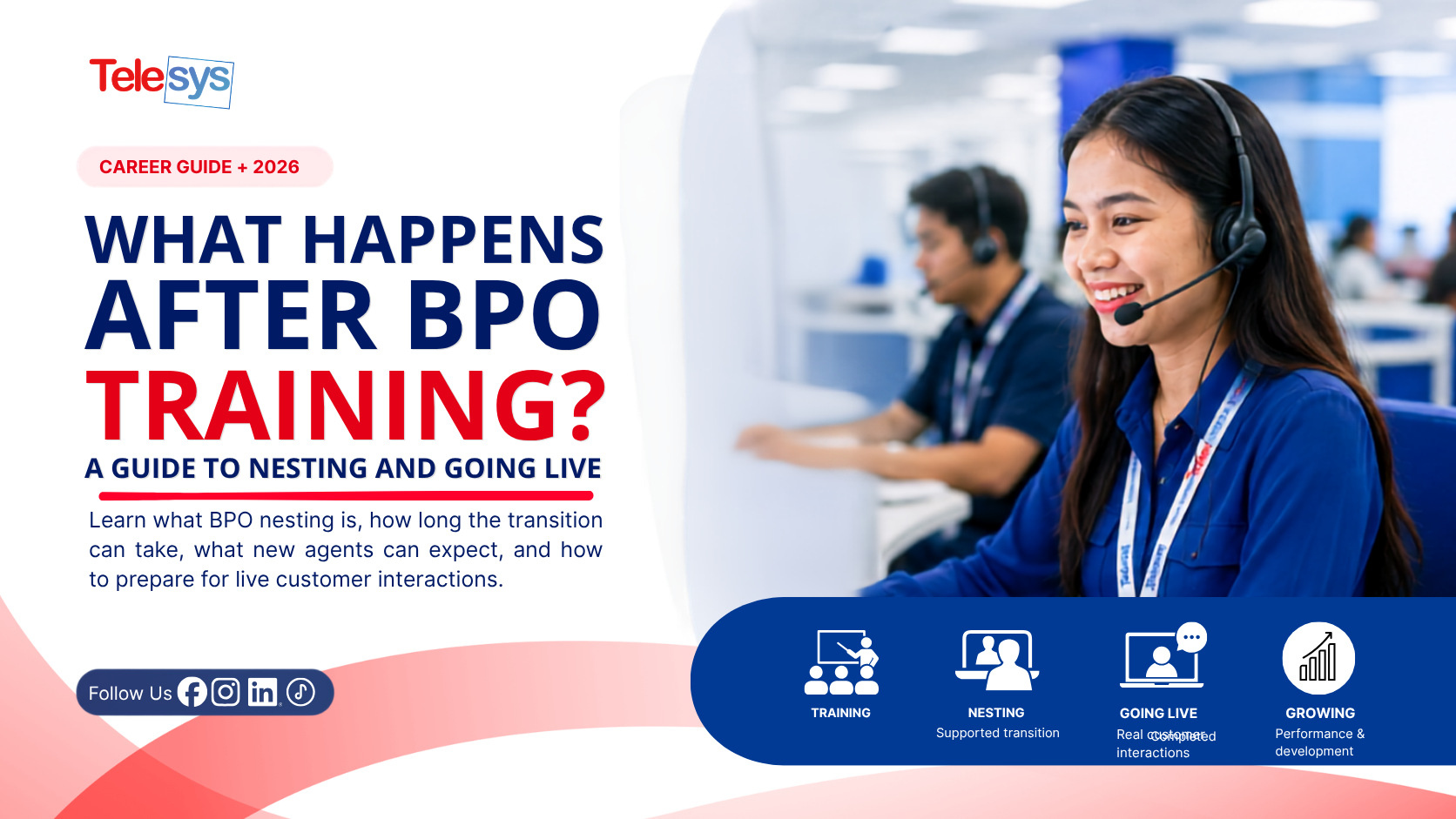
What Happens After BPO Training? A Guide to Nesting and Going Live
Starting a call center job does not usually end when classroom training is completed. For many new agents, the next step is BPO nesting, where they begin transitioning from training activities to actual customer interactions with additional support and guidance.
Understanding BPO nesting can help fresh graduates, career shifters, and new call center agents know what to expect after completing their initial training. Instead of immediately working completely independently, agents may go through a transition period that helps them apply what they learned in a real work environment.
What Happens After BPO Training?
After completing the required training, employees may move into BPO nesting before transitioning to regular production.
Nesting serves as a bridge between classroom training and actual production work. During this stage, new agents may begin handling real customer interactions while continuing to receive coaching, feedback, and support.
The exact process can vary depending on the employer, account, position, and complexity of the work.
A typical progression may look like this:
Training → Mock Calls → BPO Nesting → Regular Production
What Is BPO Nesting?
BPO nesting is a transition period where new employees begin handling actual customer interactions while still receiving additional support and guidance.
Unlike classroom training, nesting gives new agents an opportunity to apply what they learned in a real customer service environment.
During BPO nesting, agents may receive feedback about:
- Call handling
- Customer service
- Quality
- Accuracy
- Productivity
- Process compliance
- Proper use of systems
The goal is to help new agents become more comfortable with the actual responsibilities of their position.
Why Is BPO Nesting Important?
Training can teach employees the information and procedures they need. However, applying those lessons during an actual customer interaction can feel very different.
BPO nesting gives new agents an opportunity to practice in a real working environment.
During this period, agents can learn how to:
- Navigate customer interactions
- Use multiple systems at the same time
- Follow account procedures
- Search for information quickly
- Document customer concerns
- Apply troubleshooting steps
- Manage conversations professionally
- Respond to different customer situations
This transition can help new agents build confidence before working more independently.
What Happens During BPO Nesting?
The exact activities can differ depending on the account and position.
However, new agents may be expected to handle actual customer interactions while receiving monitoring, coaching, or feedback.
Handling Actual Customer Interactions
Instead of only practicing through simulations, agents may begin assisting real customers.
This allows them to apply their account knowledge and customer service skills.
Receiving Coaching and Feedback
New agents may receive feedback about their performance.
This can include areas such as:
- Call quality
- Accuracy
- Customer handling
- Process compliance
- Productivity
- Communication
Using Account Systems
Agents may need to use several applications while assisting customers.
These can include customer relationship management systems, ticketing platforms, internal databases, communication tools, knowledge bases, and documentation systems.
Learning From Mistakes
Making mistakes can be part of the learning process.
The important part is understanding the feedback, asking questions, and applying corrections to future interactions.
How Long Does BPO Nesting Usually Last?
There is no single standard duration for BPO nesting.
The length can depend on the account, position, employer, and complexity of the process.
The source training guide notes that some BPO training programs may take around 2–6 weeks, while specialized or complex accounts may require longer preparation. The actual schedule should be confirmed with the recruiter or employer because programs differ.
The same principle applies to BPO nesting. Some accounts may have a shorter transition period, while more complex processes may require additional time and support.
Important Reminder
There is no universal rule that every new call center agent will spend the same number of days or weeks in nesting.
The duration depends on the specific account and employer.
Is BPO Nesting the Same as Training?
No.
BPO training generally focuses on preparing employees for their assigned role. It may cover company policies, products, account procedures, systems, communication standards, customer service, and mock interactions.
BPO nesting, on the other hand, is the transition from training into actual customer interactions.
A simple way to understand the difference is:
| Stage | Main Purpose |
|---|---|
| Training | Learn the company, account, systems, and procedures |
| Mock Calls | Practice customer interactions |
| BPO Nesting | Apply training while receiving additional support |
| Production | Handle regular work more independently |
The exact structure can vary between accounts and employers.
What Skills Are Important During BPO Nesting?
New agents can benefit from several skills during BPO nesting.
Communication
Agents need to communicate clearly and professionally with customers.
Active Listening
Understanding the customer's concern is important before providing a solution.
Problem-Solving
Agents may need to identify the issue and determine the appropriate next step.
Computer Skills
Call center agents may need to navigate multiple applications during an interaction.
Adaptability
Every customer interaction can be different. Agents need to adjust while still following account procedures.
Time Management
Agents may need to balance customer service quality with productivity expectations.
These skills are also commonly developed during BPO training.
Is BPO Nesting Difficult for Beginners?
BPO nesting can feel challenging at first, especially for first-time call center agents.
New agents may need to handle actual customers while remembering account information, navigating systems, following procedures, and meeting performance expectations.
It is normal to need time to adjust.
New agents can make the transition easier by:
- Taking notes
- Asking questions
- Listening carefully to feedback
- Practicing consistently
- Reviewing account information
- Learning from mistakes
- Staying adaptable
The training guide also emphasizes that new employees do not need to know everything before starting training. Learning and adjustment are part of the process.
What Happens After BPO Nesting?
After BPO nesting, employees may transition into regular production.
At this point, agents may be expected to handle their responsibilities with greater independence while continuing to follow account procedures and performance standards.
However, the exact transition process depends on the account and employer.
Some employees may continue receiving coaching and performance feedback even after moving into regular production.
How Can You Prepare for BPO Nesting?
Preparing before the transition can help make BPO nesting easier.
Review Your Account Information
Keep reviewing products, services, procedures, and frequently asked questions.
Practice Using Your Systems
Become familiar with the tools and applications used for your position.
Keep Your Notes Organized
Training can provide a large amount of information. Organized notes can make it easier to find important details when needed.
Ask Questions
If a process is unclear, ask for clarification instead of making assumptions.
Listen to Feedback
Coaching is an opportunity to identify areas that need improvement.
Stay Calm
Your first real customer interactions may feel stressful. Focus on the process and apply what you learned during training.
Frequently Asked Questions About BPO Nesting
What is BPO nesting?
BPO nesting is a transition period after training where new employees begin handling actual customer interactions while continuing to receive support, coaching, and feedback.
What happens after BPO training?
After BPO training, employees may proceed to BPO nesting before moving into regular production. The exact process varies depending on the account, position, and employer.
How long is BPO nesting?
There is no universal duration for BPO nesting. The length depends on the account, complexity of the process, employer, and performance requirements.
Is BPO nesting part of training?
BPO nesting can be considered part of the overall transition from training to production, but it is different from classroom or account training. During nesting, employees may begin handling actual customer interactions.
Do new agents handle real customers during nesting?
They may. BPO nesting can involve actual customer interactions while new agents continue receiving guidance and feedback.
What is the difference between nesting and production?
Nesting is a supported transition into actual work. Production generally means handling regular responsibilities with greater independence.
Is nesting difficult for fresh graduates?
It can feel challenging because fresh graduates may be experiencing actual customer interactions for the first time. However, preparation, coaching, practice, and feedback can help make the transition easier.
Can I ask questions during nesting?
Yes. Asking questions and seeking clarification can help new agents understand procedures correctly and avoid repeating mistakes.
Final Thoughts
Completing BPO training is an important milestone, but it may not be the end of the learning process.
BPO nesting provides a transition between classroom preparation and regular production work. It allows new agents to apply their knowledge, handle actual customer interactions, receive feedback, and become more comfortable with their responsibilities.
For fresh graduates and first-time call center applicants, understanding BPO nesting can make the transition into a BPO career less intimidating.
You do not have to know everything immediately. The goal is to keep learning, listen to feedback, practice consistently, and gradually build confidence.
Explore More BPO Career Guides
Looking for more information about call center jobs, training, interviews, salaries, and career opportunities?
Visit the Telesys Website to explore available opportunities and career resources.
Read more career guides
Check out the Telesys Blog for more articles covering BPO careers, job interviews, training, salaries, and workplace tips
Want to understand what happens before BPO nesting?
Read our guide: BPO Training: What to Expect Before Starting a Call Center Job.
Browse the latest job openings
Ready to take the next step? Browse the Telesys Careers Page to explore current job opportunities.
Ready to start your BPO career?
Browse open roles at Telesys — fresh grads and career shifters welcome.